By Eliona Kola, Process Development Scientist
Every promising cell therapy begins with a critical decision: selecting starting material that can support the science today and the process as it advances. For programs built around hematopoietic stem and progenitor cells, that decision requires more than confirming that a mobilized leukopak contains a high number of cells. The right starting material must also provide the cell frequencies needed for a consistent and scalable downstream workflow.
Mobilized leukopaks can vary in total nucleated cell (TNC) yield and in the frequencies of CD34+ and CD15+ cells. Understanding how these measurements change across mobilization regimens and collection days can help development teams make more informed choices for cell isolation, enrichment, gene editing, culture, and process development.
To provide a clearer view of these differences, CGT Global evaluated successful fresh mobilized leukopak collections and shipments completed during 2025 and 2026 using donors consented under an IRB-approved protocol at CGT Global clinics. The analysis addressed one central question:
How do G-CSF-only and G-CSF plus plerixafor mobilization regimens affect TNC yield and the frequency and consistency of CD34+ and CD15+ cells in mobilized leukopaks for cell therapy research and process development?
The results reinforce a practical principle: TNC alone is not sufficient to compare mobilized leukopaks. Mobilization regimen and collection day should be reviewed alongside CD34+ and CD15+ frequencies to select starting material with the intended downstream process in mind.
Mobilization regimens evaluated
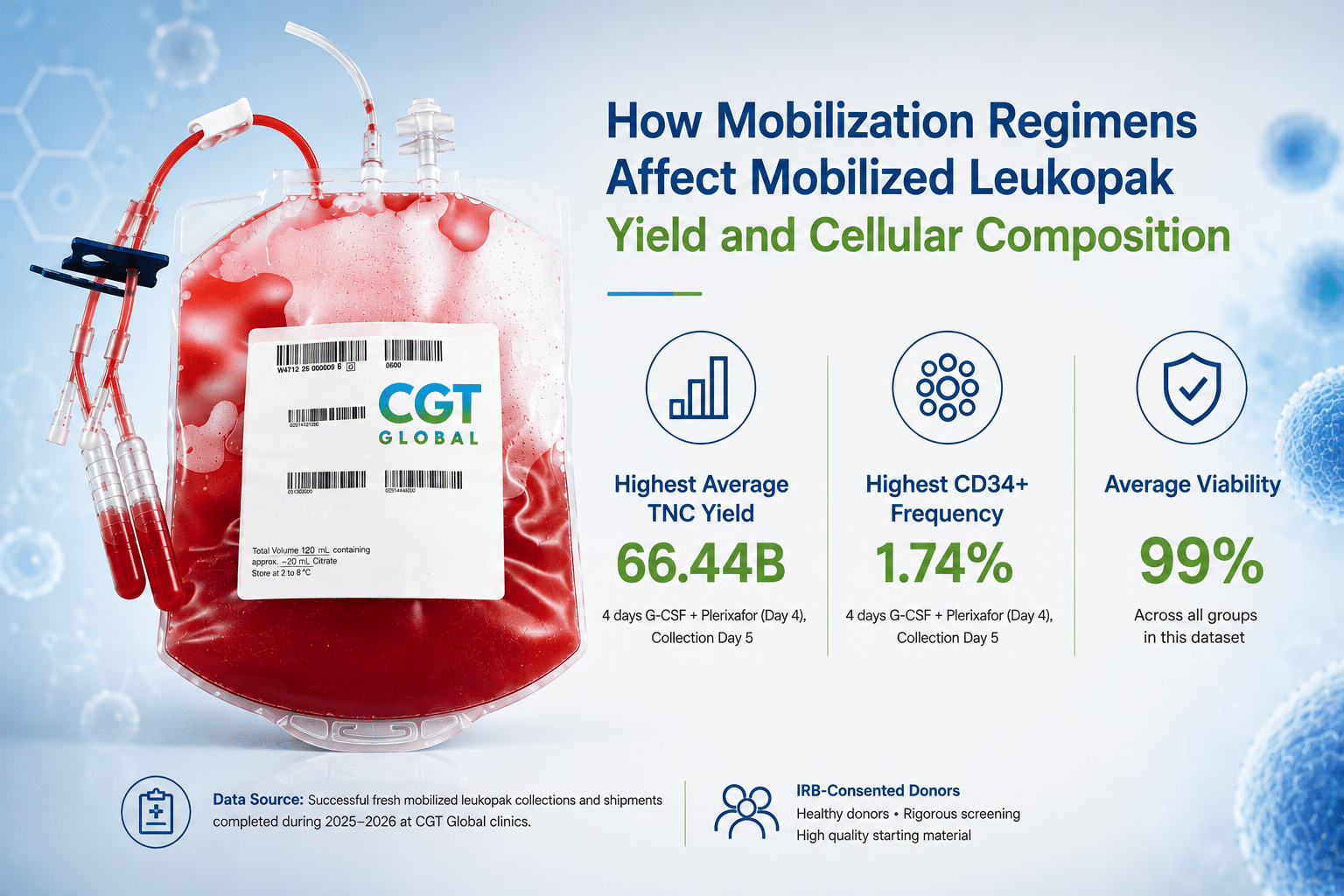
G-CSF promotes the production and release of hematopoietic cells from the bone marrow into peripheral circulation. Plerixafor is an additional mobilizing agent that may be used alone or in combination with G-CSF. Mobilized cells are subsequently collected by leukapheresis.
The dataset included four regimen categories:
-
- Four days of G-CSF with collection on Day 5 or Days 5 and 6
-
- Five days of G-CSF with collection on Day 6 or Days 6 and 7
-
- Four days of G-CSF with plerixafor on Day 4 and collection on Day 5 or Days 5 and 6
-
- Five days of G-CSF with plerixafor on the evening of Day 5 and collection on Day 6 or Days 6 and 7
Single-collection and two-day schedules were evaluated separately. For two-day schedules, Day 1 (D1) and Day 2 (D2) collections were also compared because the same donor may produce different results on consecutive collection days.
Plerixafor-containing regimens had the highest average TNC
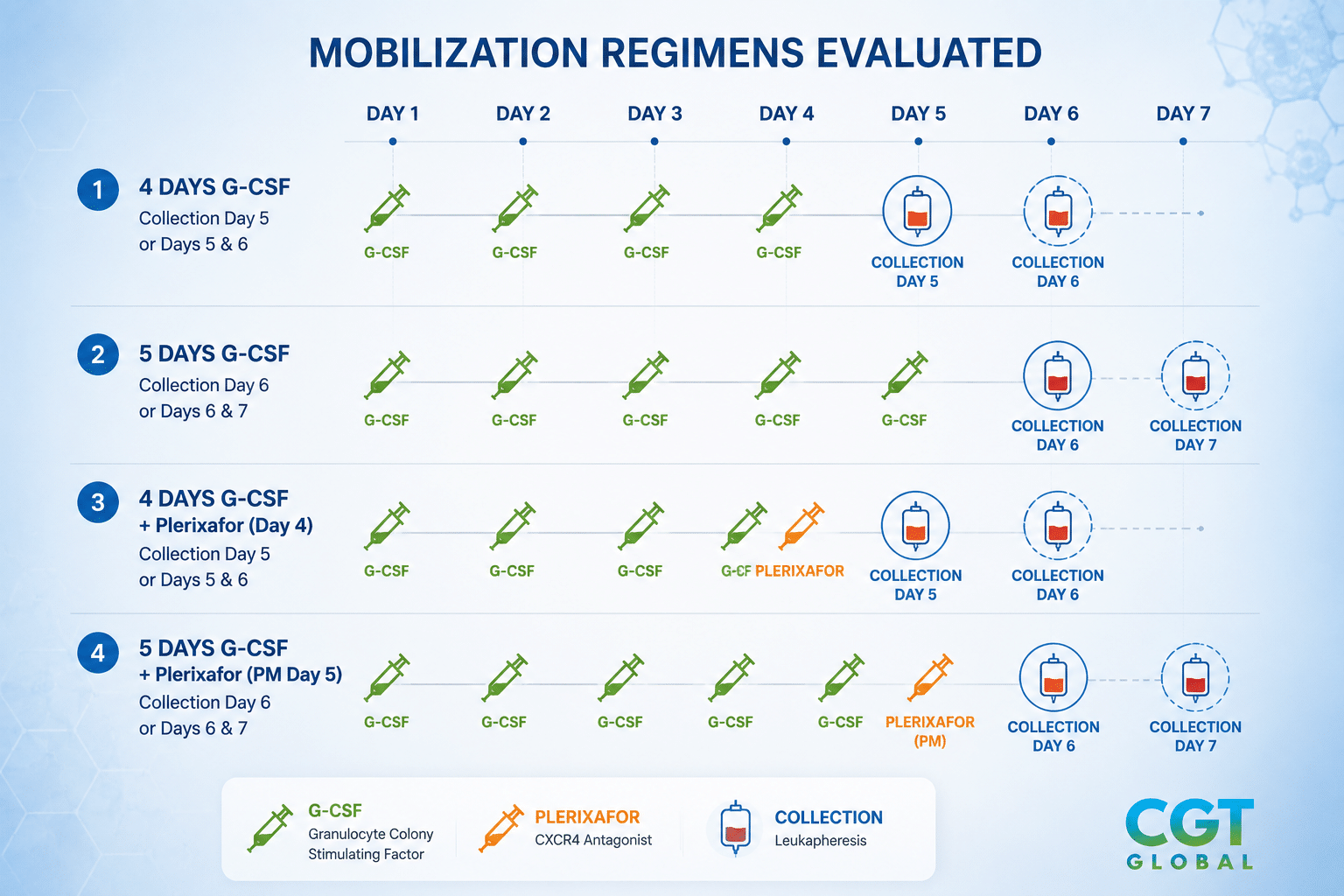
Among the single-collection groups, both plerixafor-containing regimens produced an average TNC of approximately 66 billion cells. The G-CSF-only regimens produced average TNC yields between 37.33 billion and 41.05 billion cells.
| Mobilization regimen | Collection day | Samples (n) | Average volume (mL) | Average TNC (billion) |
|---|---|---|---|---|
| Four days of G-CSF | Day 5 | 12 | 291.83 | 37.33 |
| Five days of G-CSF | Day 6 | 27 | 302.19 | 41.05 |
| Four days of G-CSF plus plerixafor on Day 4 | Day 5 | 16 | 295.38 | 66.44 |
| Five days of G-CSF plus plerixafor on the evening of Day 5 | Day 6 | 5 | 353.40 | 66.16 |
Within this dataset, the addition of plerixafor was associated with a higher average TNC for the initial collection. However, sample sizes differed among groups, and the five-day G-CSF plus plerixafor group included only five samples. The results are descriptive and should not be interpreted as evidence that one regimen will produce the highest TNC for every donor.
Similar TNC yields did not produce the same CD34+ frequency
The highest average CD34+ frequency, 1.74%, was observed after four days of G-CSF with plerixafor administered on Day 4 and collection on Day 5.
| Mobilization regimen | Collection day | Average CD34+ frequency | Average CD15+ frequency |
|---|---|---|---|
| Four days of G-CSF | Day 5 | 1.01% | 6.79% |
| Five days of G-CSF | Day 6 | 1.11% | 6.15% |
| Four days of G-CSF plus plerixafor on Day 4 | Day 5 | 1.74% | 7.00% |
| Five days of G-CSF plus plerixafor on the evening of Day 5 | Day 6 | 1.13% | 8.52% |
The two plerixafor-containing regimens produced nearly identical average TNC yields, but different average CD34+ frequencies. Four days of G-CSF plus plerixafor produced an average TNC of 66.44 billion cells and an average CD34+ frequency of 1.74%. Five days of G-CSF plus plerixafor produced an average TNC of 66.16 billion cells and an average CD34+ frequency of 1.13%.
This difference demonstrates why TNC and CD34+ frequency should be evaluated together.
Based on the group averages, the estimated CD34+ content was:
-
- 377 million cells for four days of G-CSF
-
- 456 million cells for five days of G-CSF
-
- 1.16 billion cells for four days of G-CSF plus plerixafor
-
- 748 million cells for five days of G-CSF plus plerixafor
These values were calculated by multiplying average TNC by average CD34+ frequency. They are estimates, not direct averages of donor-level absolute CD34+ yields. Donor-level absolute CD34+ yield should be calculated when the underlying collection data are available.
CD15+ frequency added a second point of comparison
Average CD15+ frequency ranged from 6.15% to 8.52% across the single-collection groups. The differences were smaller than those observed for TNC and CD34+ frequency.
CD15+ frequency may still be relevant for workflows that are sensitive to the proportion of CD15-expressing cells. It should be evaluated alongside TNC and CD34+ frequency when it could affect isolation, enrichment, culture, or processing.
D1 and D2 collections were not equivalent
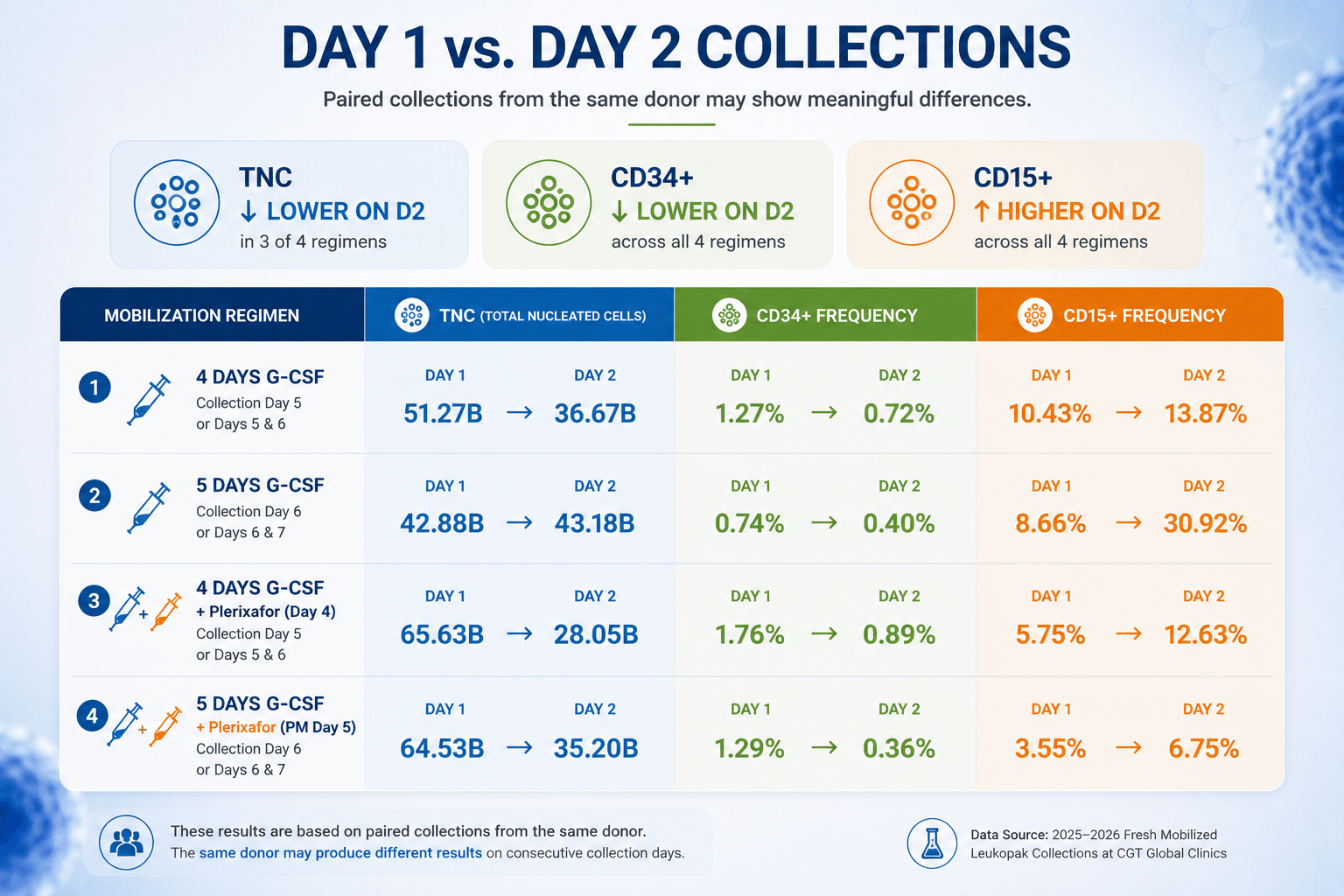
Paired collection schedules showed differences between D1 and D2 samples from the same donors.
D1 vs. D2 Collection Data
| Mobilization regimen | TNC D1 → D2 | CD34+ D1 → D2 | CD15+ D1 → D2 |
|---|---|---|---|
| Four days of G-CSF | 51.27B → 36.67B | 1.27% → 0.72% | 10.43% → 13.87% |
| Five days of G-CSF | 42.88B → 43.18B | 0.74% → 0.40% | 8.66% → 30.92% |
| Four days of G-CSF plus plerixafor | 65.63B → 28.05B | 1.76% → 0.89% | 5.75% → 12.63% |
| Five days of G-CSF plus plerixafor | 64.53B → 35.20B | 1.29% → 0.36% | 3.55% → 6.75% |
Three patterns were observed:
-
- Average CD34+ frequency was lower on D2 across all four paired groups.
-
- Average CD15+ frequency was higher on D2 across all four paired groups.
-
- Average TNC was lower on D2 in three of the four paired groups.
The five-day G-CSF-only group maintained a similar average TNC between D1 and D2. However, its average CD34+ frequency decreased from 0.74% to 0.40%, while its average CD15+ frequency increased from 8.66% to 30.92%.
This group included four paired donors. Additional data are needed to determine whether the D2 CD15+ result is representative of the regimen. The result nevertheless shows that similar TNC yields do not necessarily indicate similar CD34+ and CD15+ frequencies.
CGT Global mobilized leukopaks are collected from healthy, IRB-consented donors using FDA-approved apheresis systems. Donor-selection options may include age, sex, ethnicity, BMI, medical history, HLA type, ABO group, RhD type, and CMV status. CGT Global reports a product viability specification of at least 90% and availability with HBV, HCV, and HIV-negative donor screening. All groups in this dataset had an average reported viability of 99%.
Programs should also determine whether Research Use Only or GMP material is appropriate. Collection controls, closed-system processing, chain of custody, documentation, packaging, and shipping requirements should align with the program's development stage and intended use.
Limitations
Sample sizes were unequal, and several regimen groups were small. The analysis presents averages without donor-level ranges, standard deviations, confidence intervals, or formal statistical testing. The results describe observed patterns but do not establish statistical significance or causality.
The dataset included successful fresh collections and shipments only. Donor characteristics, individual donor response, and collection conditions may have contributed to the results. Downstream recovery, purity, expansion, transduction, editing efficiency, and functional performance were not evaluated.
D1 and D2 samples came from the same donors and should be analyzed as paired observations. Combined D1 and D2 summary rows should not be counted as additional independent samples.
Conclusion
Within this 2025 and 2026 dataset, plerixafor-containing regimens produced the highest average TNC yields in the single-collection comparison. The highest average CD34+ frequency was observed after four days of G-CSF with plerixafor administered on Day 4 and collection on Day 5.
The paired analysis also showed that D1 and D2 collections should not be assumed to be equivalent. Across all paired groups, average CD34+ frequency decreased and average CD15+ frequency increased on D2.
TNC, CD34+ frequency, absolute CD34+ yield, CD15+ frequency, and collection day should be evaluated together when selecting mobilized leukopaks. Defining these requirements early may support more informed starting-material selection and reduce avoidable variability during cell therapy research and process development.
To discuss mobilization regimens, donor selection, collection schedules, fresh or cryopreserved formats, or available characterization data, contact CGT Global.
Data source: Successful fresh mobilized leukopak collections and shipments completed during 2025 and 2026 using donors consented under an IRB-approved protocol at CGT Global clinics. Results are descriptive and may be updated as additional collections become available. Product and capability information was adapted from the CGT Global Mobilized Peripheral Blood Leukopaks page