
CGT Global Blog
CGT Global News
Stay ahead in the dynamic world of Accelerating Cell and Gene Therapy with the CGT Global blog and news page. Explore insightful articles, industry updates, product updates, and expert analysis on all things CGT Global. Stay informed, inspired, and connected with CGT Global – your go-to source for cutting-edge insights in the ever-evolving realm of research, clinical projects and healthcare.
Donor Variability in PBMC Research: How to Improve Assay Reproducibility
Donor biology and pre-analytical handling can both influence PBMC assay results. Learn how donor selection, processing controls, cryopreservation, and documentation can improve reproducibility.
Healthy Blood Donors Needed Near Philadelphia, PA
Help Support Medical Research at Our East Norriton Blood Donation Center Medical researchers rely on healthy blood donors to develop, test, and improve new approaches to understanding disease. At CGT Global’s East Norriton, Pennsylvania blood donation center, healthy donors from throughout the Philadelphia and Montgomery County area can participate in blood donation opportunities that directly support biomedical research. Unlike blood collected for transfusions, blood donated through CGT Global is collected specifically for research purposes. Researchers may use donated blood and blood-derived cells…
From Sample to Signal: How Biospecimen Quality Impacts Multiomic Assay Development
From Sample to Signal: How Biospecimen Quality Impacts Multiomic Assay Development Multiomic research allows scientists to examine biology across multiple layers, combining information from genomics, transcriptomics, epigenetics, proteomics, and other molecular measurements. By integrating these different data types, researchers can develop a more complete picture of cellular function, disease progression, treatment response, and biological variation. Modern multiomic platforms increasingly support combinations of single-cell analysis, spatial transcriptomics, protein measurement, methylation analysis, and sequencing-based workflows. However, the quality of the resulting data depends on…
The Infrastructure Behind Allogeneic Cell Therapy: Why Donor Programs Matter More Than Ever
The Infrastructure Behind Allogeneic Cell Therapy: Why Donor Programs Matter More Than Ever Cell and gene therapy has entered a new phase. For years, the industry’s primary goal was proving these therapies could work. Today, many of those questions have been answered. CAR T therapies have demonstrated remarkable outcomes in certain blood cancers, and hundreds of additional cell and gene therapy programs continue to advance through development. The conversation is now shifting. The challenge is no longer just innovation. The challenge is…

CGT Global Appoints Charlotte Ivancic to Board of Advisors, Strengthening Strategic Leadership in Cell and Gene Therapy Policy and Market Access
Charlotte Ivancic brings more than 18 years of experience on Capitol Hill, where she played a key role in shaping healthcare legislation and advising senior leadership in both the U.S. Senate and House of Representatives. Her deep expertise in healthcare policy, reimbursement, and patient access will be instrumental as CGT Global advances the field of cell and gene therapy. As these therapies continue to evolve, Ivancic will help drive scalable, practical care models designed to expand patient access and accelerate the delivery…
Leukopak vs PBMC vs Whole Blood: What’s the Difference and Which One Do You Need?
Leukopak vs PBMC vs Whole Blood: What’s the Difference and Which One Do You Need? Cell therapy, immunology, and translational research programs all rely on high quality human blood derived materials. But one of the most common sourcing questions researchers face is: Should I use whole blood, PBMCs, or a leukopak? The answer depends on your workflow, downstream application, cell yield requirements, and manufacturing stage. This guide breaks down the key differences between leukopaks, PBMCs, and whole blood so you can choose…
T Cell Activation in Cell Therapy: Why T Cell Activation Fails Without the Right Starting Material
Introduction T cell activation is a foundational step in cell and gene therapy workflows, particularly in CAR T and other adoptive cell therapies. While much attention is placed on genetic engineering and manufacturing scale, activation is where functional outcomes begin to take shape. When done correctly, it enables strong expansion, optimal phenotypes, and durable responses. When done poorly, it can limit efficacy before a therapy even reaches the patient. What Is T Cell Activation? T cell activation is the process of stimulating…
Why CGT Global Is Positioned to Support the Next Wave of Cell and Gene Therapies
Cell and gene therapy companies rely on several critical pieces of infrastructure to move therapies from development to clinical trials and ultimately to patient treatment. These include reliable sources of GMP compatible starting material, clinical trial support for complex cell therapy workflows, and hospitals capable of administering advanced therapies. Without these components in place, even the most promising therapies can face delays as developers work to coordinate donor collections, manufacturing inputs, and treatment sites. CGT Global supports therapy developers across this ecosystem…
Bulk CD34+ Isolation from Mobilized Leukopaks: GCSF vs GCSF + PLX vs PLX
Bulk CD34+ isolation is critical for stem cell therapy development, gene editing workflows, and advanced cell therapy research. When programs require large scale CD34+ recovery, the mobilization strategy used prior to leukapheresis directly impacts yield potential, scheduling timelines, and operational efficiency. Understanding the differences between GCSF mobilization, GCSF + PLX mobilization, and PLX only mobilization helps determine the optimal starting material for bulk CD34+ isolation. Bulk CD34+ Isolation from GCSF Mobilized Leukopaks GCSF mobilization is the most established and widely used strategy…
B Cell CAR T in Autoimmune Disease Breaks for Predictable Operational Reasons
Written by CGT Global B cell directed CAR T therapies are advancing quickly in autoimmune disease. As programs move beyond early trials, many teams discover that the hardest part is not engineering the cell. It is coordinating sourcing, QA, and patient delivery once timelines become real and unforgiving. In practice, B cell CAR T programs tend to break or slow down in the same places. Not because teams lack expertise, but because operational assumptions that work on paper rarely survive real world…
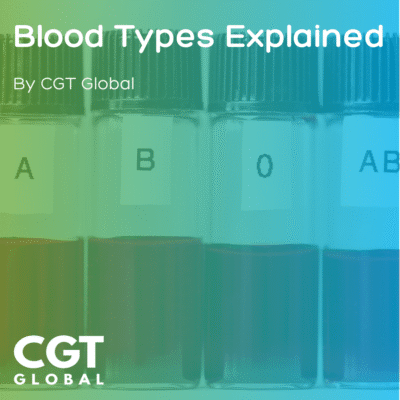
Blood Types Explained
What your blood type means and why it matters for donation and research Learn how ABO and Rh blood types work, how common each type is, and why donors are essential for lifesaving care and medical research. CGT Global donors are compensated from $25 and up to $1,000 for your time and effort depending on your donation type. Donor Compensation What Your Blood Type Means and Why It Matters for Cell Isolation and Research Learn how ABO and Rh blood types work,…